

By Denzome Sampang
Looking at the history of mankind or the world around us today, we will find that humans have always had to and have to rely on one another because, obviously, a single person cannot meet all their survival requirements. Prehistoric ancestors required others to hunt down predators, required family to raise children, formed groups to keep each other safe from harm, etc., and we continue to do so even today. Survival is much more easily achieved by staying in a group, and this was the manner in which the idea of group cohesion developed. Anthropologists at the Smithsonian point out that early societies developed systems of sharing and obligation that made survival possible.
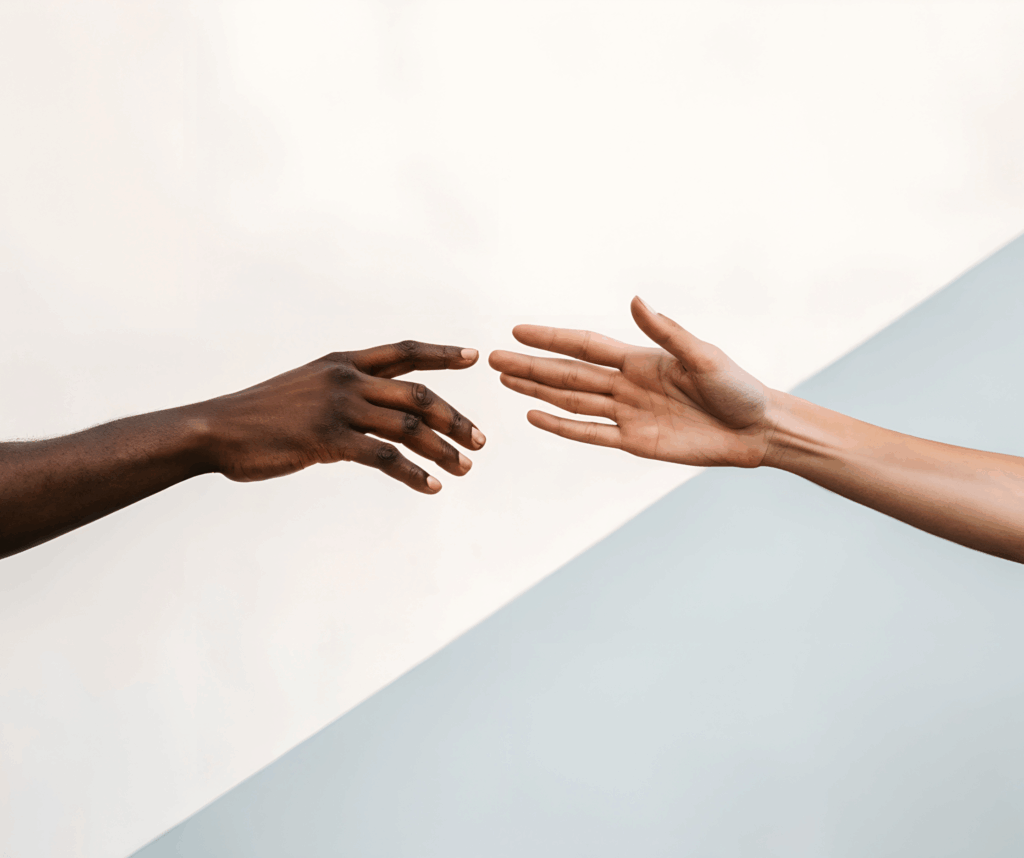
However, here is an interesting fact to understand. The bonding that brings us together can also create boundaries because more trust exists in those we are familiar with, with whom favor can be expected, than with someone who harms, which leads us to consider other groups as outsiders. This unconsciously forms an invisible border, creating the two different groups “us” and “them”. Actually, this reality is supported by numerous studies. For example, in the 1960s, evolutionary biologist W. D. Hamilton claimed that, under natural selection, individuals should favor helping immediate family members. Robert Trivers expanded this idea, explaining that even among non-relatives, cooperation can evolve when acts of help are likely to be returned. Decades later, Henri Tajfel’s experiments showed that even trivial differences, such as a preference for one abstract painting over another, were enough to divide people. These studies suggest that group bias is deeply rooted in the human mind. This is a psychological phenomenon, something called tribalism.
Primatologists have found that the instinct for tribalism is also found in animals. A study published in 2010 in Current Biology found that chimpanzees patrol the borders of their territory and sometimes launch violent attacks on neighboring groups, and often expand territory and increase access to food.
The Neolithic Revolution brought farming, permanent settlements, and surpluses. With that came specialization, one ruler on top, then a class of priests, then tens of thousands of builders and slaves at the bottom. This is how the pyramids of Egypt were built; this is how countries, religion, and ultimately division were developed. As human communities grew, division got even more extreme. Today, it is crystal clear that once division was a natural way to remain safe from predators but today we need wisdom to keep division from tearing us apart. It is because division has long been one of the most effective political weapons to gain selfish interests.
Now, the question is how people easily get manipulated to divide? The answer seems to lie in the deep human need to belong. People learned that staying in a group makes life easier; this very principle has unconsciously conditioned them to exist in a state of division. State of division, which simply means belonging, to be a part of a tribe or a circle that offers safety and recognition. So, technically, division means a form of acceptance. But when this acceptance is rebuffed, denied, in opportunity, in dignity, in justice, people suffer a psychological injury. And division ceases to be a natural form of group. Psychological research has found that when individuals are treated as outcasts or unfairly, they suffer a profound emotional injury that can often lead to strife (Tyler & Blader, 2003). Inequality, injustices, and anger turn into an unsatisfied individual, and this is where division turns dangerous. This is where opportunists step in. In these circumstances, either the voices for justice of those who are dissatisfied youths or groups are diverted and could be used by opportunists, or else, they are incited and given the space to take part in a protest deliberately so that someone’s (e.g. deep state’s) dark interest could be served. The energy of disgruntlement could, of course, be a positive, metamorphic force if appropriately directed, but it is much more likely to be harnessed to wreak havoc. Take a recent example of youth protest against nepotism and corruption in Nepal. It deserves deep studies; was that unsatisfied hunger for equal opportunities of youth turn into genuine grievances, or was that a plan to convert unsatisfied youths into the Gen-Z movement? When we see destruction and a new interim government, it looks like the Gen-Z protest got hijacked.
Most of us have heard about the Divide and Rule strategy, which is not new, by the way. If we look at history, we see that the mighty rulers often used to subjugate people by making them distrust each other, widening the social and religious differences so that they could never unite. Modern political leaders apply similar methods. They incite nationalism, play identity politics, or similar topics of issues to achieve their own political ends. Instead of accepting responsibility, they shift blame to others to foster hatred. So, division is not only about the creation of the group, it is equally poisonous when it is left unchecked. Like water, if is channeled and rightly used, it can irrigate fields, produce electricity and to a greater extent, it is a lifesaver, it can flood the fields, it can sweep away homes if misused. Simply put, division is a two-dimensional phenomenon. It can build social resilience, maintain culture, bring people together. The danger arises when it is being engineered for the selfish interest of a few. Like the situation in Rwanda, in 1994, the political elites, harnessed the radio propaganda and use it as a mechanism to stoke ethnic hatred, causing otherwise ordinary citizens to become perpetrators, the likes of which we haven’t seen since the modern era’s worst genocides So, the real change comes only when there is a true leader to understand this and understand the real acceptance and make the public aware of the reality and stay strong for the real change. Only then does division become cooperation, not conflict; resentment will end in mutual recognition.
Of course, fighting injustice is not optional. The question is how to fight. Here, Svikarokti Philosophy offers practical guidance. First thing, it helps to think critically, and a society that can think critically is harder to manipulate. It will question if the information is correct and based on fact, it will open dialogue across group which reduces bias and conflict (Pettigrew & Tropp, 2006). It says, fighting against injustice through exclusion may still produce unrest, but rather through judicial, equitable, and ideal recognition of every existence can truly bring a perfect solution. Svikarokti provides internal surveillance and awareness, which stops turning anger into chaos, instead turning dissatisfaction into constructive reform.