


Change for good governance, peace, progress, and prosperity is inevitable. That is why, through this change, we transitioned the monarchy to become a democracy. Democracies later turned into republics. But weirdly enough, somewhere down the line, we saw liberators becoming suppressors. Reformers became controllers. Seems like this happened over and over again. Here are a few examples from history when a new rule became a clone of the old rule.
Well, let’s start with the French Revolution of 1789–1799 (French Revolution Timeline, n.d.; Encyclopaedia Britannica, 2025). People marched into the streets calling for liberty, equality, and brotherhood (Roy Rosenzweig Center for History and New Media, n.d.). They successfully toppled King Louis XVI, the absolute monarchy, and feudalism (Encyclopaedia Britannica, 2025). Sadly, within four years of the new regime, trouble started. Government, led by Maximilien Robespierre, killed thousands of its own citizens in what was called the Reign of Terror between 1793 and 1794 (Encyclopaedia Britannica, 2025).
The Bolshevik Revolution in Russia (1917) followed the same pattern. Bolsheviks overthrew centuries of autocratic rule of the Tsarist regime (Pipes, 1990). However, the change was short-lived. The successor to Lenin, Joseph Stalin (1924 to 1953), proceeded to morph himself into a tyrant fueled by murderous terror who concentrated all state power in his own hands. Historian Richard Pipes described it as “the revolution betrayed by its own logic of absolute power” (Pipes, 1990).
Look what happened to Africa after its postcolonial revolutions. Robert Mugabe was hailed as a hero when Zimbabwe fought off white-minority rule. But eventually, he turned into a tyrant and devastated the economy. Author and historian Martin Meredith writes in his book entitled The State of Africa how country after country, like Ghana, all the way to Uganda, followed the same trend (Meredith, 2005). Years of freedom from colonialism through violence were replaced with decades of killing democracy via personal rule (Meredith, 2005). Many countries, including Nepal, are not immune to this trend.
George Orwell realized this idea and summarized it in his allegorical novella Animal Farm in 1945. A pig leads the charge against the authority of a human farmer, vowing to establish a socialist state founded on principles of equality. After the rebellion succeeds, however, the pig who assumes control of Animal Farm becomes a tyrant, just like his predecessor (Orwell, 1945).
Why Good People Turn Bad When They Get Power
Previous paragraphs pointed out how bad apples result from people who were once good. Empowered with power, they become corrupt and bad. But how does power do this?
A team of researchers, Galinsky et al. (2006), found that power actually decreases a person’s ability to empathize with others. In a series of studies, they examined how power influences perspective taking, discovering that powerless people are more likely to understand how other people see, think, and feel than are those who possess power (Galinsky et al., 2006).
“Iron law of oligarchy” was first introduced by German sociologist Robert Michels in 1911. The phrase suggests that regardless of how democratic the organization is at its origin, it will eventually become less democratic over time (Michels, 2000). Power becomes concentrated amongst the elite leaders. As time goes by, they start defending their own positions as opposed to that of their people. The common members become powerless.
“Power tends to corrupt, and absolute power corrupts absolutely” (Acton, 1887). Journalist Lord Acton wrote this in 1887. When people gain power, they change. When people are no longer pushed against a wall or held accountable, they become arrogant and feel entitled. They see themselves as extraordinary people who don’t have to follow normal rules and regulations (Acton, 1887).
Psychologist Carl Jung said we all have a subconscious “shadow” side we refuse to accept about ourselves. Hubris, aggression, violence, and the desire to control others are all aspects of our “shadow” (Jung, 1959). When we don’t accept these characteristics about ourselves, we project them onto others.
Political theorist Hannah Arendt in 1963 discussed the “banality of evil,” which means if one does his work without conscious thought and just by following orders, he can cause evil just by being a normal person. Hannah came to that realization while she was reporting on the trial of a Nazi bureaucrat, where she found that an average man was just doing his job, following the order blindly without knowing the fact that his simple act was leading to the Holocaust (Arendt, 1963).
Psychologist Philip Zimbardo writes about another infamous example of good people gone bad in his book The Lucifer Effect. Zimbardo found that good people could be corrupted by power. His famous Stanford Prison Experiment showcased this truth. In the experiment, the normal students were randomly assigned to be prison guards. Participants who acted as guards quickly adopted abusive behavior, even though they had no history of violence (Zimbardo, 2007).
History does not only show political leaders and individuals misusing their power. It applies even to spiritual and religious spaces, too. We have seen spiritual leaders, enlightened Gurus fallen into controversies that contradicted the very values they taught. But why do these occur? What makes the people who fight to end injustices become the new creators of them?
The answer lies in the direction of most revolutions. It is because in most cases, revolutions originate in wrath due to the suppression and are built upon opposition rather than evolution. They seek to replace rather than to reform.
Revolutionary movements tend to end up installing the same type of systems they revolted against. Even highly educated, spiritually trained, or morally motivated leaders have failed humanity.
All of these are evidence that awareness is fragile. Then what is the solution to bring real equality, equity, and proper utilization of power?
Svikarokti: the Ultimate Solution
One question humanity has pursued tirelessly for hundreds of years: Why do good people turn bad with power? As we see above, history and theories have offered good information on why it happens, but not the real answer on how to stop it from happening. Most philosophies, spiritual teachings, and leadership models emphasize awareness, but the awareness itself being so influential, it is not reliable. This is where Svikarokti comes into the picture.
Svikarokti seeks an ultimate solution. The first step is to realize that awareness alone is not enough. It should be sustainable. Our experience in Svikarokti shows that the root cause of power corrupting is the lack of sustainable awareness. Most leaders start with awareness, but that awareness at some point of time can disappear under pressure, praise, fear, and control if it is not sustainable. When sustainable awareness is absent, it spreads across society. It gives rise to bias, inequality, discrimination, and the relentless hunger for power.
Svikarokti doesn’t depend on temporary awareness. Rather, Svikarokti systematically builds sustainable awareness through a process known as Svikarokti Inner Awakening.
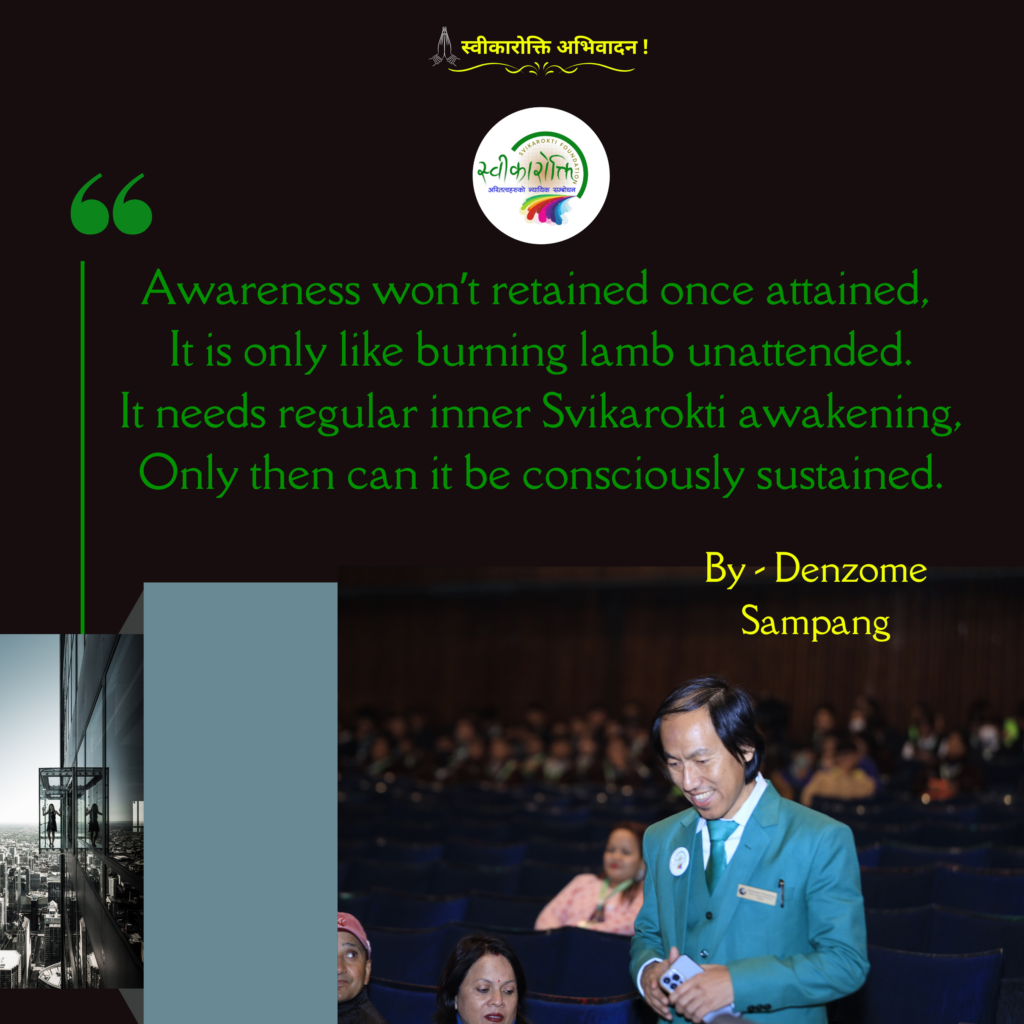
Awareness will not automatically be retained once it is attained. If it would, we wouldn’t have seen even the highly aware, experienced leaders and Gurus struggling with different controversies. Awareness is lost through conditioning of greed and slips away when distracted by power. That is why we can not leave awareness on autopilot. It needs regular renewal, just as plants need to feed with regular water, our bodies need regular exercise to remain healthy; otherwise, even the purest intentions of the mind will slowly deteriorate back into ego, greed, negative temptations, justification, control, etc.
That is why we practice Svikarokti Inner Awakening. It isn’t a one-time realization or declaration of your moral standings. Inner awakening is the daily practice that allows you to remain consciously aware of what is just, fair, and right. Inner awakening creates a habitual observation of your intentions, choices, and behavior. Inner awakening is the constant questioning of your leadership.
In Svikarokti, we never view power as something that we own. We know any position of power we have is borrowed. We are stewards of that power and must always remain accountable.
Svikarokti knows that enlightenment must persist through victory as well as trial. Many people maintain heightened awareness during challenges, but may lose it once the challenge ends. Today, the world is concerned with natural resources and environmental sustainability, but is rarely aware of awareness sustainability. That’s why Svikarokti is really talking about the sustainability of awareness in general.
Svikarokti unifies your inner world with your outer role. Psychology describes what happens to the mind when we take on power. Political science describes how systems corrupt. Spirituality describes how to wake up inside. Svikarokti encompasses all these roles by implementing sustainable awareness, and it is achieved through Svikarokti Inner Awakening.
References
Acton, J. E. E. D. (1887). Letter to Archbishop Mandell Creighton, April 5, 1887. Online Library of Liberty. https://history.hanover.edu/courses/excerpts/165acton.html
Arendt, H. (1963). Eichmann in Jerusalem: A report on the banality of evil. Viking Press.
Encyclopaedia Britannica. (2025). French Revolution. https://www.britannica.com/event/French-Revolution
French Revolution Timeline. (n.d.). italki. https://www.italki.com/en/blog/french-revolution-timeline
Galinsky, A. D., Magee, J. C., Inesi, M. E., & Gruenfeld, D. H. (2006). Power and perspectives not taken. Psychological Science, 17(12), 1068–1074. https://pmc.ncbi.nlm.nih.gov/articles/PMC8895697/
Jung, C. G. (1959). Aion: Researches into the phenomenology of the self. Princeton University Press.
Meredith, M. (2005). The state of Africa: A history of the continent since independence. Free Press.
Michels, R. (2000). Political parties: A sociological study of the oligarchical tendencies of modern democracy. Batoche Books.
Pipes, R. (1990). The Russian Revolution. Alfred A. Knopf.
Roy Rosenzweig Center for History and New Media. (n.d.). Liberty, equality, fraternity: Legacies of the revolution. https://revolution.chnm.org/exhibits/show/liberty–equality–fraternity/legacies-of-the-revolution
Zimbardo, P. G. (2007). The Lucifer effect: Understanding how good people turn evil. Random House.